

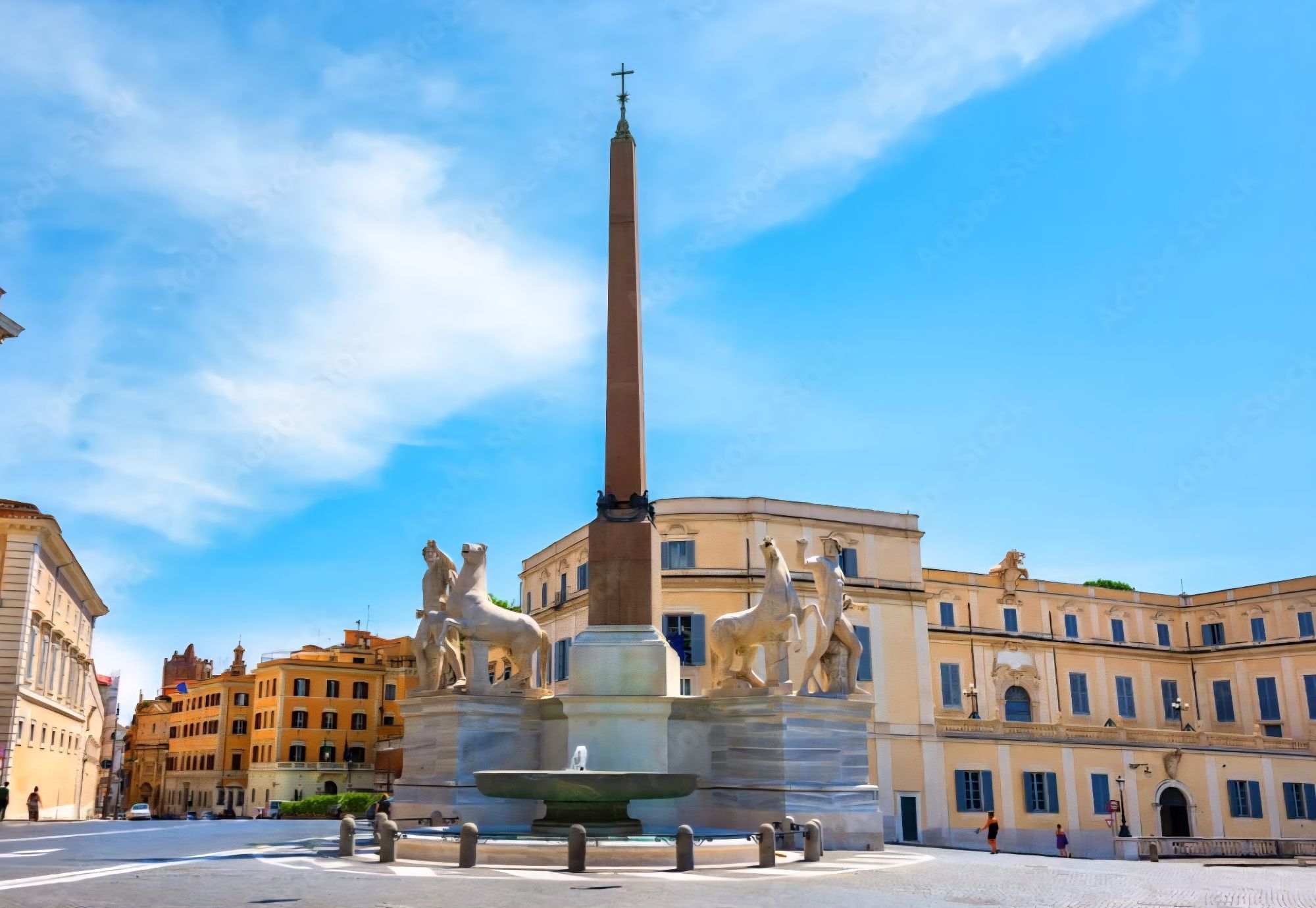
RomaTour Obelischi di Roma
Tour obelischi di Roma
R08
- Destination
Roma
- Length
25 km
- Duration
3 h 30 min
- Difficulty
- Characteristics
 Paved road
 Flat land
 Family
 Self Guided
 Easy
Easy Flat
Flat Bike
Bike
Descrizione
Rome is the city with the most obelisks in the world. Obelisks of Egyptian origin arrived in Rome starting from the age of Augustus, when Egypt was under Roman control. In pharaonic times, obelisks were considered solar symbols, placed in front of temple entrances and enriched with commemorative inscriptions. For the Romans, the gigantic basalt stelae acquired symbolic significance as war booty and testimony to imperial power. Roman-made obelisks imitating Egyptian ones, on the other hand, were created during the Domitianic period.
Subject to collapses and burial, they were discovered during excavations and erected at strategic points in the city to highlight the new urban layout.
We propose an itinerary to discover Rome's most significant obelisks starting from the Pincio, whose obelisk measures 9.247 meters; with its base and star, it exceeds 17 meters. Created by Emperor Hadrian, it was found near the Basilica of Santa Croce in Gerusalemme, close to the Aurelian Walls; hence the name Aurelian Obelisk. In 1822, Pope Pius VII had it placed in the Pincio gardens.
After a short walk along Viale Trinità dei Monti, we arrive at the Sallustian Obelisk: it measures 13.91 meters and, with its base, reaches 30.45 meters. It was created during the imperial period; the stonemasons who executed the hieroglyphs, copying them from Egyptian originals, inverted some signs.
The third stop on our tour is Piazza del Popolo. In the center rises the Flaminian Obelisk, an original Egyptian stele 24 meters high. Created in the 13th century BC, the work was transported to Rome by Augustus in 10 BC. Its original location was in the Circus Maximus; moving it to Piazza del Popolo, the place from which the three streets of the Trident branch out, was a decision by Pope Sixtus V.
The next destination, Piazza di Monte Citorio, we take Via di Ripetta to reach, after admiring the Ara Pacis, the Campus Obelisk, in front of Parliament. An Egyptian original, over 21 meters high, it arrived in Rome during the Augustan age. Initially it was placed in the Campus Martius, where it served as a gnomon for an enormous sundial of which a fragment is still visible in the foundations of San Lorenzo in Lucina. The obelisk collapsed due to a fire; Pius VI had it re-erected in its current location in 1792.
A few hundred meters and we find ourselves in Piazza della Rotonda, in front of the Pantheon, where we can admire the Macutean Obelisk, an Egyptian obelisk 6.34 meters high that reaches 14.52 meters with its base and cross. Emperor Domitian had it transported to Rome to decorate the temple dedicated to Isis and Serapis in the Campus Martius where it was found in 1373. In 1711, Pope Clement XI had it placed in its current position, on Giacomo della Porta's fountain.
Behind the Pantheon, in Piazza della Minerva, stands the smallest Egyptian obelisk in the city, the Minervan Obelisk. Just 5.47 meters high, with its base, small elephant and cross it exceeds 12 meters. Dating back to the 6th century BC, in 1667, the obelisk was erected in front of the church of Santa Maria sopra Minerva, near whose convent it had been found, by order of Pope Alexander VII. Gian Lorenzo Bernini took care of the installation, placing the stele on the small elephant and base that he designed.
In the center of Piazza Navona stands the Agonal Obelisk. Dating back to the time of Emperor Domitian, it is 16.53 meters high. Initially positioned in Albano, in 311, Maxentius wanted it for his villa on the Via Appia Antica. It was only in 1651, during the pontificate of Pope Innocent X, that Bernini placed it atop the Fountain of the Four Rivers.
In St. Peter's Square, we can admire the Vatican Obelisk. Of Egyptian origin, it is 25.5 meters high and reaches 40 meters with its base and cross. It has no carved hieroglyphs and is the only obelisk that has always remained standing. Brought to Rome by Caligula in 37 BC to embellish Nero's Circus, it was located in the area of the current sacristy of the Basilica. In 1586, it was erected in the center of the square by Sixtus V.
The next destination is Santa Maria Maggiore. In front of the basilica's apse rises the Esquiline Obelisk. Of Roman origin, it is over 14 meters high; the base and cross bring it to 25.53 meters. It was created by order of Diocletian and placed, together with its twin the Quirinal Obelisk, at the entrance to the Mausoleum of Augustus. It was discovered in 1527 and, in 1587, Pope Sixtus V had it erected in its current location by Domenico Fontana.
Via Merulana separates us from the last stop: Piazza di San Giovanni in Laterano. The Lateran Obelisk, of Egyptian origin, is the tallest monolithic obelisk in the world: it rises 32.18 meters. Created in the 15th century BC, it is therefore also the oldest in Rome. It arrived in the city in 357 by order of Emperor Constantius II and was initially placed in the Circus Maximus, where the Flaminian Obelisk was already located. It remained buried until 1587, when it was found in three pieces. In 1588, it was positioned in Piazza San Giovanni, in front of the rear entrance of the Cathedral of Rome.
Galleria



The best rental points for this route
Recommended rental points
+1 rental points available
Points of interest
Other points of interest along the route
+16Punti d'interesse
- To be seen

Ara Pacis
📍romaL Ara Pacis Augustae, comunemente chiamata Ara Pacis, uno dei monumenti pi importanti dell arte e della propaganda romana. Ecco [...]
- To be seen
Chiesa San Pietro
chiesa di san pietro
- To be seen
Obelisco Sallustiano
📍romaL Obelisco Sallustiano un obelisco situato a Roma, nella zona di Piazza Trinit dei Monti, proprio davanti alla scalinata di [...]
- To be seen
Obelisco Macuteo
📍romaL Obelisco Macuteo uno degli obelischi antichi di Roma, meno famoso di quelli grandi come il Vaticano o il Lateranense, [...]
- To be seen
Piazza di Monte Citorio
📍romaPiazza di Monte Citorio una piccola ma storica piazza situata nel centro di Roma, nel rione Campo Marzio, famosa soprattutto [...]
- To be seen
Obelisco Quirinale
📍romaL Obelisco del Quirinale un piccolo obelisco romano situato davanti al Palazzo del Quirinale, la residenza ufficiale del Presidente della [...]
- To be seen
Circo Massimo
📍RomaIl Circo Massimo un antico sito archeologico di Roma. Originariamente era uno stadio utilizzato per corse di carri e altri [...]
- To be seen
Pantheon
📍RomaIl Pantheon (in greco antico [tempio] di tutti gli dei ), in latino classico Pantheum, un edificio della Roma antica [...]
- To be seen
Basilica di San Pietro in Vaticano
📍RomaLa basilica di San Pietro in Vaticano, ufficialmente papale basilica maggiore di San Pietro in Vaticano, una basilica cattolica ubicata [...]
- To be seen
Santa croce in Gerusalemme
📍RomaLa basilica di Santa Croce in Gerusalemme una delle sette chiese di Roma facente parte del tradizionale itinerario di pellegrinaggio [...]
- To be seen
Santa Maria Maggiore
📍romaLa papale arcibasilica maggiore arcipretale liberiana di Santa Maria Maggiore, conosciuta semplicemente con il nome di basilica di Santa Maria [...]
- To be seen
Obelisco Minerva
📍romaL Obelisco di Minerva un altro obelisco di Roma, situato in Piazza della Minerva, proprio davanti alla Chiesa di Santa [...]
- To be seen
Obelisco Vaticano
📍romaL Obelisco Vaticano uno dei monumenti pi famosi di Roma e uno degli obelischi pi alti della citt . Ecco [...]
- To be seen
Obelisco Esquilino
📍romaL Obelisco Esquilino uno dei minori obelischi romani, ma interessante per la sua storia legata all area dell Esquilino. Ecco [...]
- To be seen
Piazza del popolo
📍romaLa Piazza del Popolo una delle piazze pi famose di Roma, situata all estremit settentrionale del centro storico, vicino a [...]
- To be seen
Obelisco Flaminio
📍romaL Obelisco Flaminio uno dei pi grandi e famosi obelischi di Roma, con una storia antica e una posizione centrale. [...]






APP
Travel with the official APP along the itineraries and discover all the points of interest
navigazione-semplice-e-intuitiva-per-esplorare-le-meraviglie-dellitalia-in-e-bike